Spanish Inheritance Tax for Non-Residents: Regional Allowances Explained
If you're inheriting property, savings or a business in Spain and you don't live here, the first question is almost always the same: do I actually have to pay Spanish inheritance tax as a foreigner? The short answer is yes — but how much you pay can swing from close to zero to over 30%, depending entirely on which Spanish region the deceased's assets are linked to. That single fact catches out more foreign heirs than any other part of the process.
This guide walks through how the Impuesto sobre Sucesiones y Donaciones (ISD) — Spain's inheritance and gift tax — applies to non-residents in 2026, why the region matters more than your nationality, and the deadlines that determine whether you keep your regional allowance or lose it to a late filing.
Do non-residents pay inheritance tax in Spain?
Yes. Spain taxes inheritances based on where the assets are located and, for movable assets, where the deceased or the heir was resident — not on the heir's nationality or country of residence. A UK, US, Swedish or Dutch heir inheriting a property on the Costa del Sol is liable for Spanish ISD on that property, in addition to whatever inheritance rules apply in their home country (double taxation treaties and tax credits can offset some of this, but they rarely eliminate it entirely).
Until 2014, non-residents were taxed exclusively under Spain's less generous national rules, while residents benefited from the far more favourable allowances set by their region. The Court of Justice of the EU ruled this discriminatory (Case C-127/12), and Spain amended its law so that EU/EEA non-residents could apply regional rules. In 2018, following a Spanish Supreme Court ruling, this right was extended to non-EU/EEA heirs as well — including UK nationals post-Brexit, US, Canadian and other non-European heirs. In practice, this means most foreign heirs today can choose the regional regime that applies to the assets, which is usually the better option.
Which region's rules apply to your inheritance?
This is the detail that trips up almost every foreign heir, so it's worth stating plainly:
If the deceased was a Spanish resident, the rules of the Spanish region where they lived (in the last 5 years) apply.
If the deceased was not a Spanish resident but the assets (typically property) are in Spain, the rules of the region where the highest-value asset is located apply.
So a heir living in London, inheriting from a parent who lived in Germany, for an apartment in Málaga, will generally be assessed under Andalucía's rules — not Germany's, not the UK's, and not a generic national rate.
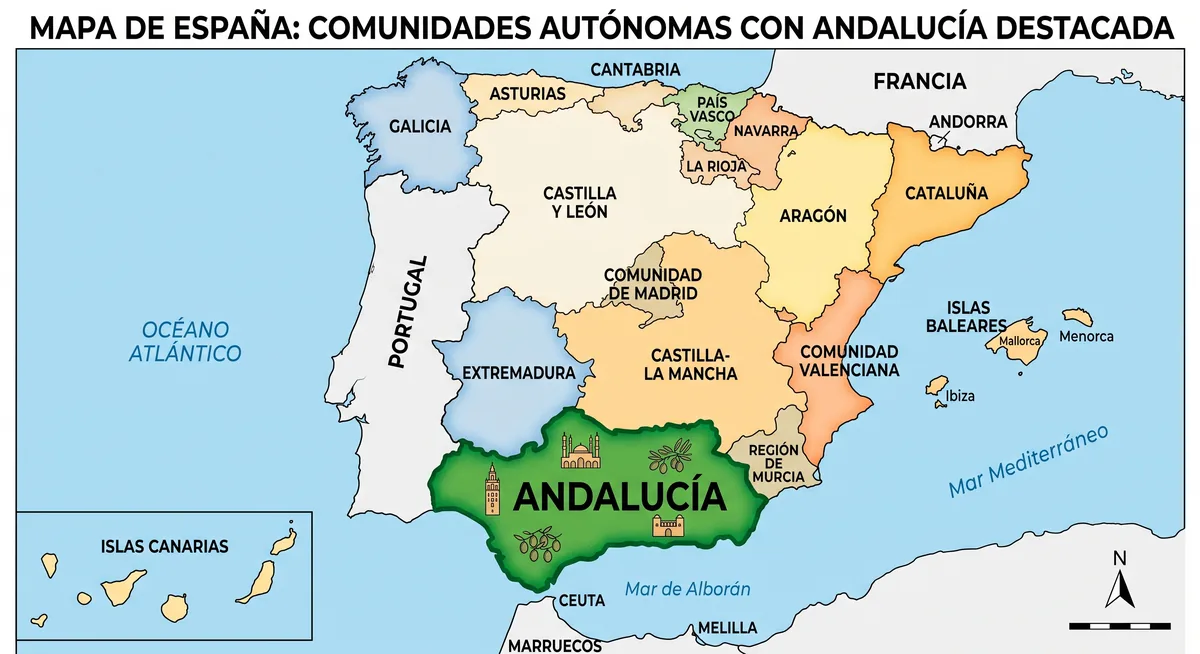
Each Spanish region sets its own allowances — and Andalusia, highlighted here, is one of the most generous.
Regional allowances: why Andalucía is different
Since 2018, Andalucía has applied one of the most generous regimes in Spain for close relatives (spouses, children, parents — Group I and II), with a bonification of up to 99% on the tax liability for inheritances up to €1 million per heir. In practice, many spouses and children inheriting a Costa del Sol property pay little to no ISD, provided the paperwork is filed correctly and on time.
Other regions relevant to foreign heirs with Spanish property:
Region
Typical treatment for spouse/children (Group I/II)
Andalucía
Up to 99% reduction for close relatives, inheritances up to €1M per heir
Comunidad Valenciana
Significant reduction for close relatives, with its own thresholds
Región de Murcia
Reduction for close relatives, lower than Andalucía
Madrid
Near-total exemption (99%) for spouses, children and parents
(Rates and thresholds are set by each region's own legislation and are revised periodically — always confirm the current-year figures before filing; this table is a general orientation, not a substitute for a calculation on your specific case.)
Distant relatives and unrelated heirs (Groups III and IV — siblings, nieces/nephews, unmarried partners without registered status, friends) receive far smaller or no reductions in most regions, and can face effective rates well above 20-30%. This is one of the most common surprises for blended and non-traditional families inheriting in Spain.
The 6-month deadline that decides whether you keep the allowance
Spanish inheritance tax must be self-assessed and paid within 6 months of the date of death, using Modelo 650. This deadline applies whether or not probate abroad has concluded, and whether or not the heir has visited Spain.
Two things heirs frequently get wrong:
Missing the deadline entirely. A one-off, 6-month extension can be requested, but it must be applied for within the first 5 months — not after the original deadline has passed. Filing late without requesting an extension triggers a surcharge of 1% plus 1% for each full month of delay (no interest, capped at 15% after 12 months); past 12 months the surcharge is a flat 15% plus late-payment interest, and in some cases the loss of certain time-sensitive regional bonifications.
Filing under the wrong region's rules, either by mistake or because a generic online calculator defaulted to national rates. This alone can be the difference between paying under Andalucía's 99% bonification and paying full national rates.
Getting the paperwork right is what protects your regional allowance.
What foreign heirs need before filing
NIE (Número de Identificación de Extranjero) for every heir — this cannot be filed without it, and obtaining one from abroad takes time, so it should be requested as early as possible.
Spanish death certificate registration (or apostilled foreign death certificate with certified translation).
Certificate of Last Wishes (Certificado de Últimas Voluntades) confirming whether a Spanish will exists.
Title deeds (escritura) and an up-to-date Nota Simple from the Land Registry for any property.
Valuation of the estate at the date of death — Spain does not simply accept a foreign probate valuation; the tax base is usually the higher of the declared value or the regional reference value (valor de referencia del Catastro).
Common costly mistakes
Assuming a will made in the home country automatically resolves the Spanish inheritance tax obligation — it doesn't; ISD must still be filed in Spain regardless of where probate is granted.
Delaying because "there's no Spanish will" — Spain does not require a Spanish will to inherit Spanish assets, and delaying to sort this out eats into the 6-month deadline.
Not requesting the extension in time, forfeiting it by even a day.
Using the national tax table when the regional table (usually far more favourable) should apply.
Frequently asked questions
Do I pay Spanish inheritance tax if I already paid inheritance tax in my home country?
Possibly both — Spain taxes assets located in Spain regardless of tax paid elsewhere. Some double taxation treaties or unilateral relief provisions allow a credit, but this needs to be assessed case by case; it is not automatic.
Is there a general "spouse exemption" like in some other countries?
No blanket exemption, but Group I/II heirs (spouse, children, parents) benefit from the largest regional reductions — in Andalucía and Madrid this can approach a full exemption for estates up to certain thresholds.
What happens if I miss the 6-month deadline?
A surcharge of 1% plus 1% per full month of delay applies, with no interest, up to a cap of 15% at 12 months; past 12 months the surcharge is a flat 15% plus late-payment interest. In some cases you can also lose access to time-limited regional reductions.
Do non-EU heirs (e.g., UK, US) get the same regional allowances as EU heirs?
Since a 2018 Spanish Supreme Court ruling, yes — non-EU/EEA heirs are entitled to apply the same regional rules as residents and EU heirs, where the assets are located in Spain.
An inheritance is, first, a family matter.
Next step
Every estate is different, and the region, the relationship to the deceased, and the value and type of assets all change the final tax bill significantly. Our team at Sánchez Solicitors' Inheritance & Wills service can run a Spanish inheritance tax simulation for your specific case and confirm which region's rules apply before the 6-month deadline puts pressure on the decision. If your inheritance also raises questions about your ongoing tax status in Spain, our non-resident tax service can review that alongside the inheritance itself.
To provide the best experiences, we use technologies such as cookies to store and/or access device information. Your consent to these technologies allows us to process data such as browsing behavior or unique identifiers on this site. Withholding or withdrawing consent may negatively affect certain features and functions.
Functional
Always active
Storage or technical access is strictly necessary for the legitimate purpose of enabling the use of a specific service explicitly requested by the subscriber or user, or for the sole purpose of carrying out the transmission of a communication through an electronic communications network.
Preferencias
El almacenamiento o acceso técnico es necesario para la finalidad legítima de almacenar preferencias no solicitadas por el abonado o usuario.
Statistics
Storage or technical access that is used exclusively for statistical purposes.El almacenamiento o acceso técnico que se utiliza exclusivamente con fines estadísticos anónimos. Sin un requerimiento, el cumplimiento voluntario por parte de tu proveedor de servicios de Internet, o los registros adicionales de un tercero, la información almacenada o recuperada sólo para este propósito no se puede utilizar para identificarte.
Marketing
El almacenamiento o acceso técnico es necesario para crear perfiles de usuario para enviar publicidad, o para rastrear al usuario en una web o en varias web con fines de marketing similares.