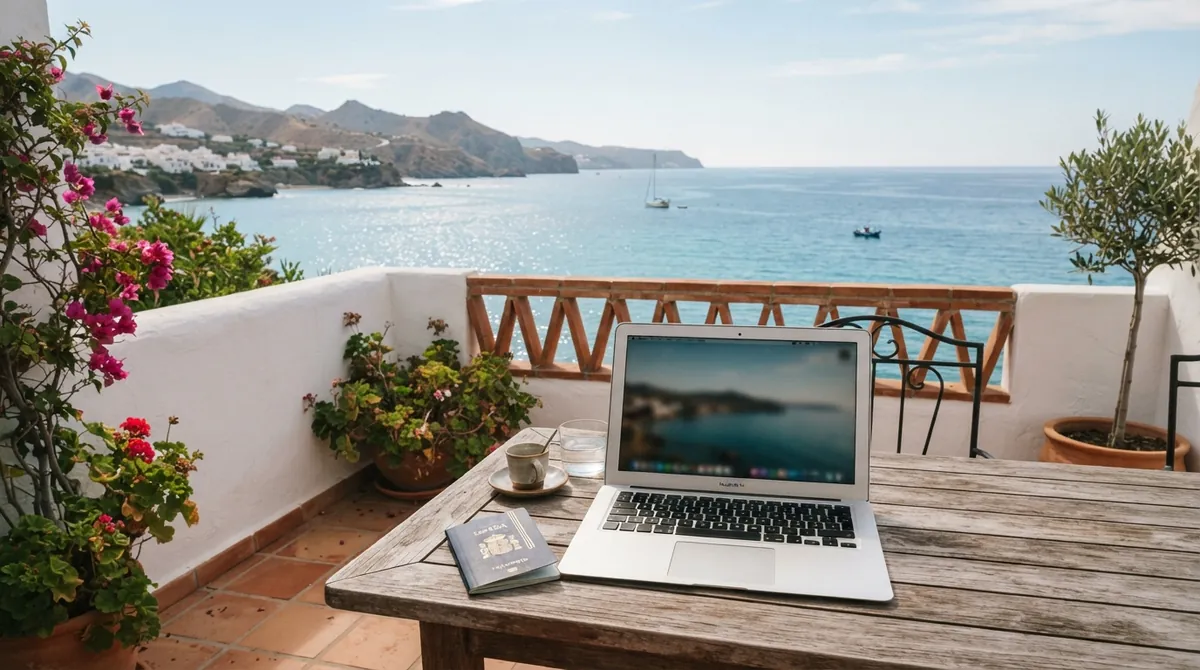
Both visas let you live in Spain. Only one lets you keep working.
Non-Lucrative vs Digital Nomad Visa in Spain 2026: The Essential Comparison
Non-lucrative vs digital nomad visa is the first decision most non-EU families face when they plan a move to Spain. Both routes give you legal residence, both need private means and health cover, and both can lead to long-term residence. The difference that decides almost everything is work: the non-lucrative visa is for people who will live here without working, while the digital nomad visa is for people who will keep working remotely for companies outside Spain.
This guide compares the two side by side with the 2026 figures: income thresholds, who qualifies, where you apply, how long each permit lasts, what happens with your family and how you are taxed once you live here. It reflects the rules as checked in November 2026 under the current Immigration Regulation (Real Decreto 1155/2024) and the Entrepreneurs Law (Ley 14/2013). It is general information, not legal advice on your case.
Non-Lucrative vs Digital Nomad Visa: The Key Difference
The non-lucrative visa (visado de residencia no lucrativa) allows you to live in Spain "without carrying out work or professional activities", in the words of the Ministry of Inclusion, Social Security and Migration. You support yourself with savings, a pension, rental income or investments. Remote work for a foreign employer is not allowed under this permit, and the official guidance on remote workers confirms that the non-lucrative permit does not authorise work.
The digital nomad visa, officially the residence for international teleworkers, was created by the Startups Law (Ley 28/2022) and added to Ley 14/2013. It allows you to live in Spain while working at a distance for a company based outside Spain, as an employee or as a freelancer. So the honest first question in the non-lucrative vs digital nomad visa choice is simple: will you keep earning from work once you live here? If the answer is yes, the non-lucrative route is closed to you.
Who the Non-Lucrative Visa Is For
The non-lucrative visa suits retirees, people living from savings or investments, and families who want a year or more in Spain without a job here. The main requirements are:
Financial means: 400% of the IPREM for the applicant and 100% for each family member, per month, for the whole stay. With the IPREM frozen at €600 a month in 2026, that is €2,400 a month or €28,800 a year for one person.
Health insurance: public or private, with an insurer authorised to operate in Spain. Many consulates ask for full cover without co-payments, so check your consulate's list before you buy a policy.
Clean criminal record: certificates from every country where you lived in the last five years.
Medical certificate: confirming you have no disease with serious public health implications under the International Health Regulations.
You apply in person at the Spanish consulate for your place of residence, not from Spain, and you pay the fee on form 790, code 052. The first authorisation lasts one year from your entry into Spain.
Who the Digital Nomad Visa Is For
The digital nomad visa suits employees of foreign companies and freelancers with foreign clients whose work can be done entirely online. According to the Large Companies Unit (Unidad de Grandes Empresas, UGE), which handles these permits, you need:
A foreign employer or clients: the company must have been operating for at least one year, and your employment or professional relationship must have lasted at least three months before you apply.
Qualifications or experience: a university degree or recognised training, or at least three years of experience in similar roles.
Income from work: 200% of the minimum wage (SMI), explained in the next section.
Health cover: registration with Spanish Social Security, or a private policy with an insurer authorised in Spain, without co-payments or waiting periods.
Social Security: employees need their employer registered in Spain or a certificate of cover from their home country under a bilateral agreement. Freelancers must register as self-employed (RETA).
Employees may only work for their foreign employer. Freelancers may also work for Spanish clients, but that work cannot exceed 20% of their total professional activity.
Income Requirements and Family Members in 2026
The income tests are where the non-lucrative vs digital nomad visa comparison often surprises people. The non-lucrative visa is tied to the IPREM, which has not changed since 2023 because the State budget has been extended. The digital nomad visa is tied to the minimum wage, which rose to €1,221 a month in 14 payments for 2026 (Real Decreto 126/2026). Spread over 12 months, that is €1,424.50, and 200% is about €2,849 a month.
2026 figures
Non-lucrative visa
Digital nomad visa
Main applicant
€2,400/month (€28,800/year)
About €2,849/month (€34,188/year)
First family member
+€600/month
+about €1,068/month (75% of SMI)
Each additional member
+€600/month
+about €356/month (25% of SMI)
Couple
€3,000/month
About €3,917/month
Where the money comes from
Savings, pensions, rents, investments
Your remote work
Two practical points. For the non-lucrative visa, consulates usually want to see the full year's amount, in a bank balance or as regular passive income. For the digital nomad visa, the figures above use the annual minimum wage divided by 12, which is how the threshold is normally applied, but check the calculation your consulate or the UGE uses before you file.
Family members also differ. Under the digital nomad route, your spouse or partner and children receive authorisations that let them work without restrictions. Under the non-lucrative route, the whole family is in the same position as you: living here, but not working.
Where You Apply, How Long Each Permit Lasts and Renewals
The non-lucrative visa is always requested at a consulate abroad. After the first year, you renew for two years. To renew, you must have lived in Spain for more than 183 days in the calendar year, kept your health insurance and still have enough means. You can file in the two months before expiry, or up to three months after, although a late filing may lead to a penalty procedure.
The digital nomad route offers two doors. From abroad, the consulate issues a visa valid for up to one year, and within the 60 days before it expires you apply to the UGE for a residence authorisation. If you are already in Spain legally, for example during a visa-free stay, you can apply to the UGE directly for a residence authorisation of up to three years, with a fee of €73.26. Renewals are for periods of two years while the conditions are still met.
Under both routes, five years of continuous legal residence open the door to long-term residence, which no longer depends on the original permit.
Tax: What Changes When You Live in Spain
Whichever visa you choose, living here usually makes you a Spanish tax resident. If you spend more than 183 days in Spain in a calendar year, or your main centre of economic interests is here, you pay personal income tax (IRPF) on your worldwide income at progressive rates, and you may have to report assets held abroad. Your double tax treaty decides which country taxes certain income, such as some public pensions.
This is where the digital nomad visa can carry a real advantage. Remote workers who move to Spain can opt for the special regime for workers relocated to Spain, known as the Beckham law, if they have not been tax resident here in the previous five years. Under it, employment income is taxed at 24% up to €600,000 and 47% above, for the year of arrival and the five following years, and the option is filed on Modelo 149 within six months of starting the activity. For freelancers the rules are stricter, so get advice before you count on it. The non-lucrative visa does not give access to this regime, because it does not involve work.
Which One Fits You?
If you are retired or living from your savings, and you are happy not to work in Spain, the non-lucrative visa is usually the simpler route, with a lower income threshold. If you work remotely for a foreign company or for foreign clients, the digital nomad visa is the right one, and the only one of the two that lets you keep earning. If you plan to work for a Spanish company or open a business aimed at the Spanish market, neither is the right tool, and you should look at work or self-employment permits instead.
The risk is choosing on the income figure alone. A remote worker who enters on a non-lucrative visa to save on the threshold is working without authorisation, which can cost the renewal and create a tax problem at the same time. Settling the non-lucrative vs digital nomad visa question correctly at the start is cheaper than fixing it later.
Frequently Asked Questions
Can I work remotely on a non-lucrative visa?
No. The permit is for living in Spain without carrying out work or professional activities, and the Ministry treats remote work as incompatible with it. If you will keep working, the digital nomad visa is the route designed for you.
Can I apply for the digital nomad visa from inside Spain?
Yes, if you are in Spain legally, you can apply to the UGE for a residence authorisation of up to three years without returning to your country. The non-lucrative visa, by contrast, must be requested at a consulate abroad.
Do I become a Spanish tax resident with either visa?
Usually yes, once you spend more than 183 days a year in Spain. The non-lucrative renewal itself requires more than 183 days of residence, so planning your taxes is part of planning your visa.
Next Step: Check Which Visa Fits Your Situation
The right answer depends on where your income comes from, who moves with you and how you will be taxed, and a mistake at the start can cost you a renewal. At Sánchez Solicitors we prepare non-lucrative and digital nomad applications for foreign families and remote workers, in your own language, and we look at the tax side at the same time, so the non-lucrative vs digital nomad visa decision is made once and made well.
To provide the best experiences, we use technologies such as cookies to store and/or access device information. Your consent to these technologies allows us to process data such as browsing behavior or unique identifiers on this site. Withholding or withdrawing consent may negatively affect certain features and functions.
Functional
Always active
Storage or technical access is strictly necessary for the legitimate purpose of enabling the use of a specific service explicitly requested by the subscriber or user, or for the sole purpose of carrying out the transmission of a communication through an electronic communications network.
Preferencias
El almacenamiento o acceso técnico es necesario para la finalidad legítima de almacenar preferencias no solicitadas por el abonado o usuario.
Statistics
Storage or technical access that is used exclusively for statistical purposes.El almacenamiento o acceso técnico que se utiliza exclusivamente con fines estadísticos anónimos. Sin un requerimiento, el cumplimiento voluntario por parte de tu proveedor de servicios de Internet, o los registros adicionales de un tercero, la información almacenada o recuperada sólo para este propósito no se puede utilizar para identificarte.
Marketing
El almacenamiento o acceso técnico es necesario para crear perfiles de usuario para enviar publicidad, o para rastrear al usuario en una web o en varias web con fines de marketing similares.