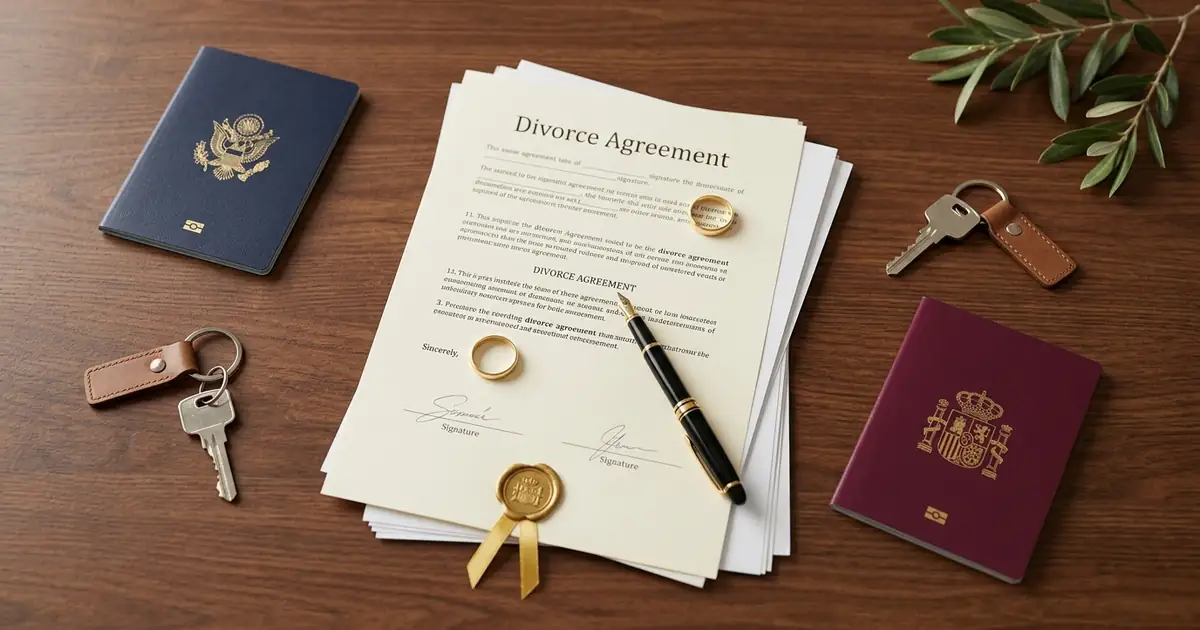
A divorce between spouses of different nationalities is not harder to start in Spain, but it asks for decisions early: which court, which law and which route.
Divorce in Spain for Foreign Couples 2026: Essential Guide to Process and Costs
Divorce in Spain for foreign couples is entirely possible, and it is more straightforward than most people expect: Spain does not ask you to prove fault or to separate first, and you do not need Spanish nationality to use its courts. What decides the outcome is the order of your decisions. Which court has jurisdiction, which country's law applies, whether you can divorce at a notary or need a judge, and what happens to property and children are questions that, for a foreign couple, have to be answered before anything is filed.
This guide follows that order using the rules in force in 2026: the European jurisdiction and applicable-law regulations, the three-month rule, the notarial, court-agreed and contested routes, the mediation step that became compulsory in 2025 for most contested family claims, what a divorce realistically costs, and how Spanish and foreign decrees are recognised across borders.
Divorce in Spain for Foreign Couples: Jurisdiction and Applicable Law
Spanish courts apply the EU rules on jurisdiction in matrimonial matters (Regulation 2019/1111, the "Brussels IIb" Regulation). A Spanish court can hear your divorce if, among other grounds, you are both habitually resident in Spain; if you were last habitually resident here and one of you still lives here; if the respondent lives here; if you apply jointly and either of you lives here; if the applicant has lived here for at least a year before filing; or if the applicant has lived here for at least six months and is a Spanish national. Common Spanish nationality is another ground. Nationality is therefore not the test for most foreign couples: where you actually live is.
Which law the court applies is a separate question, governed by the Rome III Regulation (1259/2010). Spouses can agree on the law that governs their divorce, choosing among the law of their habitual residence, the law of their last common residence if one of them still lives there, the law of either spouse's nationality, or Spanish law as the law of the court. If they have not chosen, the court applies a fixed order, starting with the law of the country where they are habitually resident. For couples who live in Spain, that usually means Spanish law, but a written choice of law made in advance can change the outcome, so it is worth deciding deliberately.
If proceedings are already open in another country, or your spouse is about to start them, seek advice before you file in Spain. The United Kingdom is no longer bound by the European regulations, so a Spanish case and a British one can run in parallel, and the court that gets there first can matter.
No Grounds Needed, but a Three-Month Rule Applies
Since the 2005 reform, divorce in Spain requires no cause and no prior separation. Either spouse can ask for it, with or without the other's consent, and the court does not look at who is to blame. The only timing rule is that three months must have passed since the wedding, unless there is proof of risk to the life, physical or moral integrity, liberty or sexual freedom of the applicant or the children.
For foreign couples this has a practical effect: the marriage does not need to have been celebrated in Spain. A foreign marriage can be dissolved by a Spanish court if the jurisdiction rules above are met, although you will normally need the marriage certificate with an apostille and a sworn translation into Spanish.
Notary, Court by Agreement or Contested: Which Route?
There are three routes for divorce in Spain for foreign couples, and the main dividing line is whether you agree and whether you have dependent children.
Before a notary or the court clerk. If you both agree on everything and have no minor children and no adult children under court-ordered support measures that depend on you, you can divorce without going before a judge: either at a notary, who signs a divorce deed, or before the court clerk (letrado de la Administración de Justicia). Both spouses must sign a regulatory agreement (convenio regulador) and, at the notary, they must be assisted by a practising lawyer. The notary then notifies the Civil Registry.
Court, by agreement. If you agree but have minor children, the agreed divorce goes before a judge, who checks the agreement protects the children and approves it. This usually involves a short hearing and is considerably faster and cheaper than a trial.
Contested. If one spouse does not agree, or you cannot settle the terms, the divorce is decided by the court after a full procedure. It is the slowest and most expensive route, and it is the one where preparation, evidence and the right order of decisions make the biggest difference.
Mediation Before a Contested Divorce (MASC)
Since 3 April 2025, Organic Law 1/2025 requires an attempt at an out-of-court solution (known as a MASC) before filing most contested civil claims, including contested family proceedings such as divorce with disputed measures about children, maintenance or property. A genuine negotiation or a first mediation session counts, and courts have accepted a documented settlement proposal that the other side refused to negotiate.
The requirement does not apply to agreed divorces, nor, under the criteria published by the Madrid family judges, where you only ask the court to dissolve the marriage without disputing any measures. Practice still varies between courts, so the MASC attempt should be planned and documented from the beginning rather than left until the claim is rejected for lack of it.
Property, Maintenance and Children
The divorce itself ends the marriage; the effects have to be settled too. For property, the default regime in most of Spain is the community of assets (sociedad de gananciales), where what was acquired during the marriage is split equally, while Catalonia and the Balearic Islands default to separate property. For couples with international ties, which law governs the matrimonial property regime is determined by Regulation 2016/1103 for couples who married, or chose the applicable law, on or after 29 January 2019, and by the older conflict rules before that. A prenuptial agreement signed abroad can matter, so bring it.
Spousal maintenance (pensión compensatoria) is not automatic. Article 97 of the Civil Code grants it only when the divorce creates an economic imbalance for one spouse, and the court looks at factors such as the length of the marriage, age, health, employability and time devoted to the family. Where children are involved, the court sets child maintenance and the custody arrangement based on the child's best interests, and shared custody has become increasingly common in Spanish courts. Children old enough to understand are heard by the judge, and in any case if they are over twelve.
Relocating abroad with the children after the divorce is a point to settle in the agreement from the start, because moving a child to another country without the other parent's consent or a court order can lead to return proceedings under the Hague Convention.
Costs and Timeline of Divorce in Spain for Foreign Couples
The cost depends mainly on whether you agree. In an agreed divorce, the notary's fee for the deed is usually in the range of €100 to €300, and the lawyer's fee makes up most of the rest; recent Spanish press estimates put the total of an agreed divorce at up to about €2,500, depending on complexity, children and shared assets, and a contested divorce can easily exceed €4,000 to €6,000. These are market estimates, not tariffs, and they rise in large cities and with extra work such as translations, apostilles or valuation of property.
Court fees (tasas judiciales) are not an extra for individuals: natural persons have been exempt from them in all jurisdictions since 2015. Timing follows the same logic. A notarial divorce can often be completed within weeks, an agreed court divorce within a few months, and a contested divorce can take months or even years, which is the best reason to try to agree on the key terms first.
Foreign Divorces and Spanish Divorces Abroad: Recognition
If you divorced abroad and need that divorce to count in Spain, the route depends on where the decree comes from. A decision from another EU Member State is recognised automatically under Regulation 2019/1111 and can be registered in the Spanish Civil Registry with the corresponding certificate. For decrees from outside the EU, including the United Kingdom since Brexit, recognition generally requires a court procedure called exequatur under Law 29/2015 on international legal cooperation, unless a treaty between Spain and the country says otherwise.
In the opposite direction, a Spanish divorce is valid in Spain and, within the EU, will be recognised in other Member States. Whether it is recognised in your home country outside the EU depends on that country's own rules, so check this before relying on it, especially if you plan to remarry or settle property abroad.
Frequently Asked Questions
Do I have to be a Spanish resident to divorce in Spain?
Not necessarily. Several jurisdiction grounds do not require both spouses to live in Spain, but they depend on where you live and for how long, so the exact facts matter.
Can we divorce without a lawyer?
In a notarial divorce, the law requires the spouses to be assisted by a practising lawyer, and a contested divorce needs a lawyer and a procurador for each side, so in practice you will need legal assistance.
Will a divorce affect my residence permit?
It can, if your permit depends on your marriage or on your spouse's status. Check this with an immigration lawyer before you file, so the timing of the divorce does not put your own residence at risk.
Next Step: Divorce Without Surprises
The mistakes that cost foreign couples the most time and money in a divorce are avoidable: filing in the wrong country, not choosing the applicable law, skipping the MASC attempt, or signing an agreement that does not cover property and children properly. At Sánchez Solicitors we handle the whole process for international couples, from the choice of route to the agreement, the court procedure and the registration of the decree, so that your divorce in Spain for foreign couples follows the rules that apply to you.
To provide the best experiences, we use technologies such as cookies to store and/or access device information. Your consent to these technologies allows us to process data such as browsing behavior or unique identifiers on this site. Withholding or withdrawing consent may negatively affect certain features and functions.
Functional
Always active
Storage or technical access is strictly necessary for the legitimate purpose of enabling the use of a specific service explicitly requested by the subscriber or user, or for the sole purpose of carrying out the transmission of a communication through an electronic communications network.
Preferencias
El almacenamiento o acceso técnico es necesario para la finalidad legítima de almacenar preferencias no solicitadas por el abonado o usuario.
Statistics
Storage or technical access that is used exclusively for statistical purposes.El almacenamiento o acceso técnico que se utiliza exclusivamente con fines estadísticos anónimos. Sin un requerimiento, el cumplimiento voluntario por parte de tu proveedor de servicios de Internet, o los registros adicionales de un tercero, la información almacenada o recuperada sólo para este propósito no se puede utilizar para identificarte.
Marketing
El almacenamiento o acceso técnico es necesario para crear perfiles de usuario para enviar publicidad, o para rastrear al usuario en una web o en varias web con fines de marketing similares.